
Having already introduced readers of my blog to Krampus the Christmas Devil (who I am happy to say is gaining popularity in America, having recently made an appearance on the Colbert Report) it is now time for us to get acquainted with the rest of Krampus' family of dark Old World yuletide monsters.
One of Krampus' close relative is the Stallos; Yeti-like yuletide beasts from the country of Lapland home of the Sámi people.
The Stallos are traditionally depicted as hairy giants (sometimes with horns) dressed in the chain-mail armor of a Viking berserker; a fact which explains the name Stallo which literally means “metal man.” Though the Stallos are never descried as being intelligent they are regarded as cunning and have access to magical powers such the ability to see the future.
Though the Stallos possess the same impressive stature as traditional Scandinavian giants they should not be confused with them. Author Johan Turi notes that the main difference between the Stallos and the giants was that the giants did not “hate mankind like the stallos did.” In Sámi mythology, giants are also regarded as being kin to mankind (both decedents of the Sun god) while the Stallos are described as being “half human and half troll or devil.”
Perpetually plagued by thirst the Stallos roams the countryside on Christmas Eve looking for fresh water to drink. Sámi yuletide tradition involves driving a stake into the ground near the closet body of water so that the Stallos can easily find it. If a Stallo does not find any fresh water to quench his thirst than he will be forced to enter the home and bash in the skulls of the resident children lapping up their brains and blood instead.
On a related note, lakes that lack fish or are covered in a heavy coat of green moss are said to be poisoned by a Stallo body which was evidently buried nearby.
 The Stallos could also prove a threat to young women as the monster “delights in macabre acts of genital mutilation of his innocent victims. (Stallo pokes his staff up the skirts of young girls.)” In the myths and legends of the Sámi it is possible for a young girl to be courted and even married off to a Stallo though the marriage will ultimately end badly. Stories like these are used by Sámi parents as a kind of reverse of the traditional Beauty and the Beast fable with the lesson here being that marriage to “a beast” of a man is ultimately a bad idea.
Though a freighting semi-supernatural monster the Stallo was still mortal and could be killed. In the legend of Potto-Podnie a young shepherd boy confronts a Stallo and overcomes the monster beheading the beast with its own sword.
The legends of the Stallo were probably based in part on the Sámi people’s encounters with foreign invaders such as the Vikings. Subsequent Sámi generations kept the legend alive by prescribing the traits of the Stallo to other human invaders such as the Tschudes, Christian missionaries, and in the 1940s the Nazis.
Today the Stallo remains a reminder of Christmas' darker roots in world mythology and legend.
Pictures:
At Top: The Lapland heraldic coat of arms depicts a Stallo-like wildman on it. Similar wildmen can be seen on heraldic shields throughout Europe.
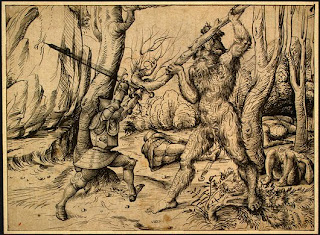
Middle: A knight confronts a Stallo-like wildman in Hans Burgkmair's "The Fight in the Forest ," 1500 CE
Sources/More Information:
Santa is a Wildman (2002) by Jeffery Vallance
The Stallo Throughout Sámi and World History by Andrew F. Besa
One of Krampus' close relative is the Stallos; Yeti-like yuletide beasts from the country of Lapland home of the Sámi people.
The Stallos are traditionally depicted as hairy giants (sometimes with horns) dressed in the chain-mail armor of a Viking berserker; a fact which explains the name Stallo which literally means “metal man.” Though the Stallos are never descried as being intelligent they are regarded as cunning and have access to magical powers such the ability to see the future.
Though the Stallos possess the same impressive stature as traditional Scandinavian giants they should not be confused with them. Author Johan Turi notes that the main difference between the Stallos and the giants was that the giants did not “hate mankind like the stallos did.” In Sámi mythology, giants are also regarded as being kin to mankind (both decedents of the Sun god) while the Stallos are described as being “half human and half troll or devil.”
Perpetually plagued by thirst the Stallos roams the countryside on Christmas Eve looking for fresh water to drink. Sámi yuletide tradition involves driving a stake into the ground near the closet body of water so that the Stallos can easily find it. If a Stallo does not find any fresh water to quench his thirst than he will be forced to enter the home and bash in the skulls of the resident children lapping up their brains and blood instead.
On a related note, lakes that lack fish or are covered in a heavy coat of green moss are said to be poisoned by a Stallo body which was evidently buried nearby.
 The Stallos could also prove a threat to young women as the monster “delights in macabre acts of genital mutilation of his innocent victims. (Stallo pokes his staff up the skirts of young girls.)” In the myths and legends of the Sámi it is possible for a young girl to be courted and even married off to a Stallo though the marriage will ultimately end badly. Stories like these are used by Sámi parents as a kind of reverse of the traditional Beauty and the Beast fable with the lesson here being that marriage to “a beast” of a man is ultimately a bad idea.
Though a freighting semi-supernatural monster the Stallo was still mortal and could be killed. In the legend of Potto-Podnie a young shepherd boy confronts a Stallo and overcomes the monster beheading the beast with its own sword.
The legends of the Stallo were probably based in part on the Sámi people’s encounters with foreign invaders such as the Vikings. Subsequent Sámi generations kept the legend alive by prescribing the traits of the Stallo to other human invaders such as the Tschudes, Christian missionaries, and in the 1940s the Nazis.
Today the Stallo remains a reminder of Christmas' darker roots in world mythology and legend.
Pictures:
At Top: The Lapland heraldic coat of arms depicts a Stallo-like wildman on it. Similar wildmen can be seen on heraldic shields throughout Europe.
Middle: A knight confronts a Stallo-like wildman in Hans Burgkmair's "The Fight in the Forest ," 1500 CE
Sources/More Information:
Santa is a Wildman (2002) by Jeffery Vallance
The Stallo Throughout Sámi and World History by Andrew F. Besa


